Blog
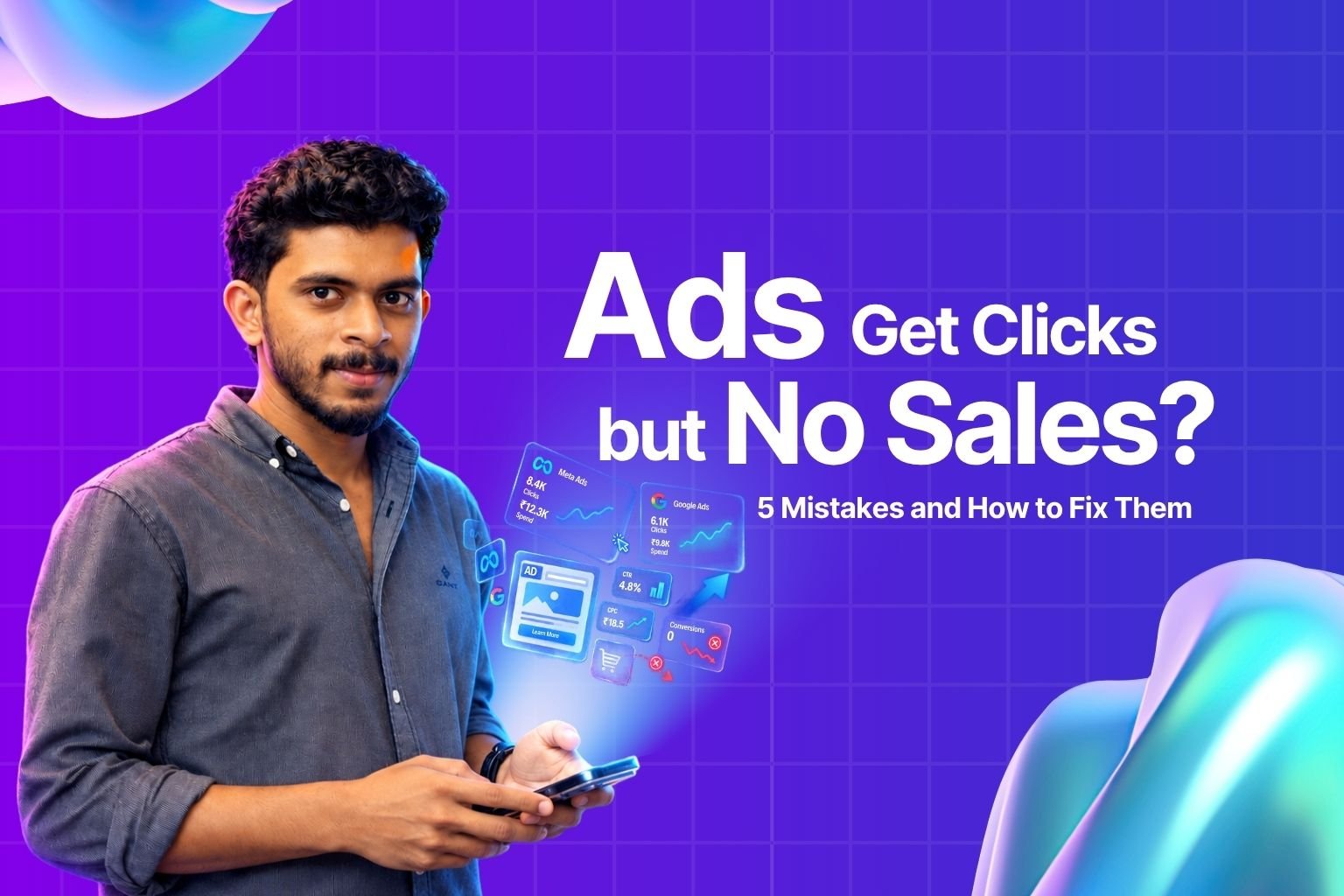
Ads Get Clicks but No Sales? 5 Mistakes and How to Fix Them
October 22, 2026
Introduction
Your ad is getting clicks. People are interested enough to visit your website. But somehow, the sales are still not coming in.
This can be frustrating, especially when you are spending money on every click.
The problem may not be the number of people clicking your ad. It could be what happens before, during, or after the click.
Here are five common mistakes that can stop your ad clicks from turning into sales, along with practical ways to fix them.
Why Are My Ads Getting Clicks but No Sales?
Getting clicks does not necessarily mean people are ready to buy. Your ad may be attracting the wrong audience, making the wrong promise, sending people to a weak landing page, or giving them no strong reason to purchase.
Think about the journey:
Ad → Click → Landing Page → Interest → Action → Sale
A problem at any stage can affect the final result.
For example, an ad may get hundreds of clicks because the creative is interesting. But if the landing page is confusing or the offer does not match what the ad promised, those clicks may not turn into customers.
This is why looking only at clicks can give you an incomplete picture of your advertising performance.
What Are the 5 Mistakes That Can Stop Ad Clicks From Becoming Sales?
1. Is Your Ad Reaching the Wrong Audience?
If the wrong people are clicking your ads, you can get plenty of traffic without getting sales.
Your advertising needs to reach people who are actually likely to need your product or service.
Depending on your business, this could involve factors such as:
- Location
- Age group
- Interests
- Behaviour
- Buying intent
- Previous interactions with your business
For example, a premium interior design company may get clicks from people who are interested in interior design but are not currently looking to hire an interior designer.
The ad is getting attention, but the audience is not necessarily ready to become a customer.
How can you fix it?
Review who is actually seeing and clicking your ads. Make sure your targeting matches the type of customer you want to attract.
Possible internal link: Performance Marketing Services
2. Does Your Ad Promise Something Your Website Does Not Deliver?
Your landing page should give visitors what they expected when they clicked the ad.
Imagine an advertisement promoting a special website design package. Someone clicks because they are interested in that specific offer.
Instead of seeing the package, they land on a general homepage with no clear information about it.
The visitor now has to search for what they originally came for.
That extra effort can be enough for them to leave.
Your ad and landing page should feel like parts of the same experience.
Ad promise → Landing page message → Customer action
How can you fix it?
Make sure the headline, offer, visuals, and message on your landing page match what the advertisement tells people they will get.
Possible internal link: Website Development Services or Landing Page Development
3. Is Your Landing Page Making It Difficult to Buy?
A good advertisement can bring someone to your website, but a poor landing page can lose them.
Visitors should be able to quickly understand:
-
What you are offering
-
Why it is useful to them
-
What makes your offer different
-
What they should do next
A cluttered page, confusing navigation, slow loading time, or difficult enquiry form can create unnecessary friction.
People should not have to figure out how to contact you or purchase from you.
How can you fix it?
Keep the landing page focused on one main goal.
Use clear information, relevant visuals, trust signals, and an obvious call to action.
If the goal is to generate enquiries, make the enquiry process simple.
If the goal is to sell a product, make it easy to understand the product and complete the purchase.
4. Is Your Offer Strong Enough?
Sometimes the problem is not the advertisement or the website. The offer itself may not give people enough reason to buy.
A person can be interested in your product and still decide not to purchase.
They may be thinking:
-
Why should I choose this?
-
Is this worth the price?
-
What do I actually get?
-
Why should I buy this now?
-
What makes this business different?
Your ad needs to communicate value, not just announce that your product or service exists.
For example, instead of simply advertising “Digital Marketing Services Available”, a business could communicate a specific service, benefit, or package that solves a particular problem.
How can you fix it?
Look at your offer from the customer's point of view.
Clearly communicate what they get, who it is for, and why it is worth considering.
The answer does not always have to be a discount. A useful package, free consultation, bonus service, limited-time offer, or clear guarantee can sometimes make the proposition stronger.
5. Are You Tracking What Happens After the Click?
Clicks alone cannot tell you whether your advertising is actually generating business.
You need to understand what happens after someone clicks.
Depending on your campaign, useful metrics can include:
-
Click-through rate
-
Landing page conversions
-
Leads
-
Cost per lead
-
Enquiries
-
Purchases
-
Cost per acquisition
-
Return on ad spend
For example, imagine your campaign receives 1,000 clicks.
That number may look impressive.
But if only two people enquire and nobody purchases, the clicks are not telling the full story.
This is where performance marketing becomes important.
The focus is not simply on getting attention. It is on understanding whether your advertising is contributing to measurable business results.
Possible internal link: Performance Marketing Services
How Can You Fix Ads That Get Clicks but No Sales?
Start by looking at the complete customer journey instead of changing everything at once.
1. Check Your Audience
Are the people clicking your ads actually potential customers?
2. Review Your Ad Creative
Does the advertisement clearly communicate what you offer and why it matters?
3. Look at Your Offer
Is there a clear reason for someone to choose your product or service?
4. Improve Your Landing Page
Does the page match the advertisement and make the next step obvious?
5. Check Your Call to Action
Are you clearly telling visitors what to do next?
6. Study Your Campaign Data
Look beyond views and clicks. Find where people are dropping off.
You do not necessarily need to completely restart a campaign. Sometimes one weak part of the journey is responsible for most of the problem.
Should You Increase Your Ad Budget If You Are Not Getting Sales?
Increasing your budget will not fix a campaign that is already failing to convert.
If your targeting, offer, landing page, or conversion process has a problem, spending more money may simply produce more clicks without more sales.
It is better to first understand why people are not converting.
Once the campaign is performing well, increasing the budget can make more sense.
When Should You Get Professional Help With Your Advertising?
Professional help can be useful when you are spending money on advertising but cannot clearly identify what is working and what is not.
A good advertising strategy can involve much more than creating an ad and choosing an audience.
It can include:
- Audience research
- Campaign strategy
- Ad copy
- Creative design
- Video production
- Landing pages
- Conversion tracking
- Campaign analysis
- Ongoing optimisation
The goal should not simply be to get more clicks.
It should be to build an advertising journey that gives those clicks a better chance of becoming enquiries, sales, or other valuable actions.
How Can Konzepta Help Turn Ad Clicks Into Customers?
Konzepta can help businesses look beyond clicks and build advertising campaigns around actual business goals.
From advertising strategy and creative development to performance marketing, video production, and website experiences, each part of the customer journey can influence the final result.
If your ads are getting attention but not producing the results you expect, the first step is to understand where potential customers are dropping off.
Possible internal link: Advertising Services
CTA: Want to get more from the money you spend on advertising? Talk to Konzepta about building a more conversion-focused advertising strategy.
Frequently Asked Questions About Ads Getting Clicks but No Sales
Why are my ads getting clicks but no sales?
There isn't a fixed timeframe for redesigning a website. Instead, look at whether your website still meets your customers' expectations, supports your business goals, and performs well.
Why are people clicking my ads but not buying?
A click shows interest, but it does not always show buying intent. The visitor may need more information, a stronger offer, more trust, or a simpler buying process.
Should I stop my ads if they are not generating sales?
Not necessarily. First identify where the problem is. Improving the targeting, creative, offer, landing page, or tracking may improve campaign performance.
How do I know if my advertising campaign is working?
Look beyond views and clicks. Depending on your goal, track leads, enquiries, purchases, conversion rate, cost per acquisition, or return on ad spend.
Should I increase my advertising budget?
Only after you understand how well the campaign is converting. Increasing the budget on a poorly converting campaign can increase spending without improving sales.
Final Thoughts
Getting clicks is only one part of a successful advertising campaign.
If your ads are getting attention but not generating sales, look at the entire journey from the audience seeing the ad to the moment they are expected to make a purchase.
The right audience, a strong advertisement, a relevant landing page, a convincing offer, and proper tracking all work together.
Instead of asking only “How many people clicked my ad?”, ask:
“What happened after they clicked?”
That is where you can often find the real reason your advertising is not generating sales
Ready to Turn More Clicks Into Sales?
THE NEXT STEP
Your Ads Are Getting Clicks. Let's Turn Them Into Customers.
Build a smarter advertising strategy with Konzepta and focus on what matters — real business results.