
Is Your Website Actually Bringing You Customers?
Blog
What Is the Difference Between Advertising and Performance Marketing?
October 24, 2026
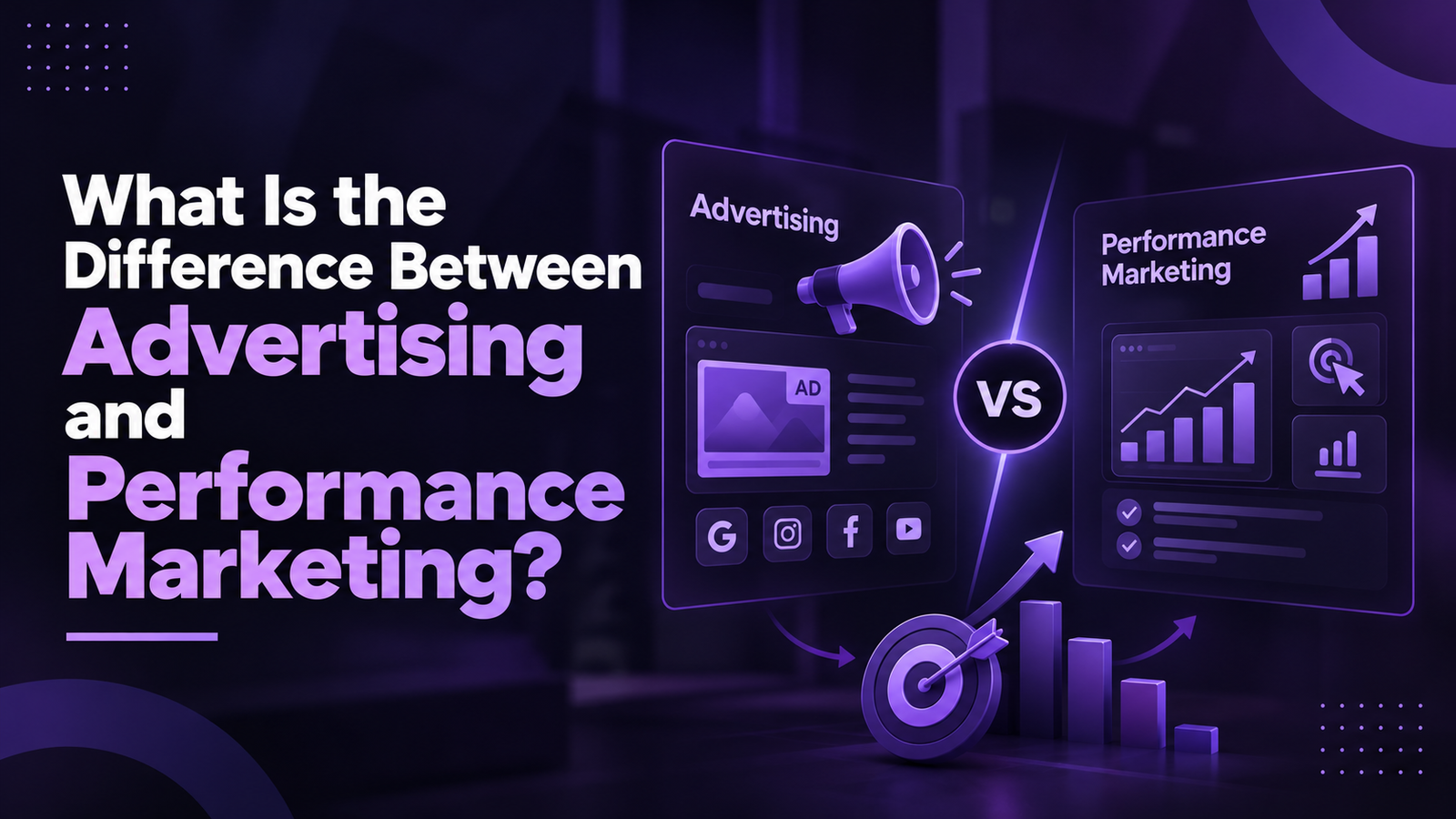
Running an advertisement and running a performance marketing campaign may look similar from the outside, but the way success is planned and measured can be very different.
A business may spend money to put an ad in front of thousands of people. Another may spend the same amount while closely tracking how many leads, sales, or enquiries that advertising generates.
So, what is the difference between advertising and performance marketing?
The main difference is the focus. Advertising is often used to reach and influence an audience, while performance marketing focuses more strongly on measurable actions and business results.
Understanding this difference can help you decide where your marketing budget should go and what you should actually be measuring.
What Is Advertising?
Advertising is a way for businesses to pay to promote their products, services, or brand to a target audience.
You see advertising almost everywhere.
A business might advertise through:
- Google Ads
- Social media ads
- YouTube
- Display advertising
- Newspaper advertisements
- Outdoor advertising
- Television
- Radio
- Video advertisements
The goal can vary depending on the campaign.
A business may want to introduce a new product, increase brand awareness, promote an offer, attract visitors to its website, or generate enquiries.
For example, a new restaurant may run an Instagram advertisement showing its food to people in a particular city.
The immediate goal may simply be to get more people to know about the restaurant.
What Is Performance Marketing?
Performance marketing is a results-focused approach where campaigns are planned, measured, and optimised around specific actions or business outcomes.
Instead of stopping at questions such as:
How many people saw the advertisement?
A performance-focused campaign may also ask:
How many people clicked?
How many became leads?
How many purchased?
How much did each customer cost?
How much revenue did the campaign generate?
The exact metrics depend on the business and its goal.
For an ecommerce company, purchases and revenue may be important.
For a service business, qualified enquiries or leads may matter more.
For an app, installs or subscriptions could be the main goal.
The important part is that the campaign has a measurable objective and uses data to understand what is working.
What Is the Main Difference Between Advertising and Performance Marketing?
Advertising is primarily about communicating with an audience, while performance marketing places greater emphasis on measurable results and continuous optimisation.
This does not mean advertising cannot generate sales or that performance marketing ignores awareness.
The two can overlap.
The difference is more about how the campaign is approached and what success is measured against.
For example:
| Advertising | Performance Marketing |
|---|---|
| Reach an audience | Drive measurable actions |
| Build awareness | Generate leads, sales, or conversions |
| Measure reach and impressions | Measure conversions and business outcomes |
| Focus on communication | Focus on the full customer journey |
| Campaign results may be reviewed periodically | Data is used continuously to optimise campaigns |
A campaign can use the same platforms, such as Google or Meta, and still be approached very differently depending on its objective and measurement strategy.
Does Performance Marketing Mean You Only Pay When Someone Buys?
No, performance marketing does not necessarily mean you only pay when someone makes a purchase.
This is a common misunderstanding.
Performance marketing refers more broadly to a results-driven approach where campaigns are measured against defined actions and optimised using performance data.
Depending on the campaign, those actions could include:
- Clicks
- Leads
- Enquiries
- Sign-ups
- App installs
- Purchases
- Bookings
For example, a business selling high-value services may not get a sale immediately after someone clicks an advertisement.
The first valuable action might be an enquiry or consultation request.
The campaign can therefore be optimised around generating qualified leads rather than expecting every click to immediately become a sale.
What Metrics Are Used in Advertising?
Advertising campaigns can be measured using metrics such as reach, impressions, clicks, engagement, and click-through rate.
These metrics can help you understand whether people are seeing and interacting with your advertisements.
Some common advertising metrics include:
Reach
Reach tells you how many people were shown your advertisement.
It helps you understand the size of the audience your campaign reached.
Impressions
Impressions show how many times your advertisement was displayed.
One person can see an advertisement more than once, so impressions can be higher than reach.
Clicks
Clicks show how many times people interacted with the advertisement by clicking it.
Clicks can indicate interest, but they do not automatically mean that someone will become a customer.
Engagement
Engagement measures interactions such as likes, comments, shares, or other actions depending on the platform.
These numbers can help show how people are responding to the content.
What Metrics Are Used in Performance Marketing?
Performance marketing usually goes further by connecting campaign activity to measurable actions and business outcomes.
Common metrics can include:
Conversion Rate
Conversion rate shows the percentage of users who complete a desired action.
That action could be submitting a form, making a purchase, booking an appointment, or signing up.
Cost Per Lead
Cost per lead shows how much you are spending to generate each lead.
This can be especially useful for businesses that depend on enquiries rather than direct online purchases.
Cost Per Acquisition
Cost per acquisition measures how much it costs to acquire a customer or another defined conversion.
This can help businesses understand whether the campaign is financially sustainable.
Return on Ad Spend
ROAS measures the revenue generated in relation to advertising spend.
For example, if a campaign generates ₹50,000 in tracked revenue from ₹10,000 in ad spend, the ROAS is 5.
The metric you choose should always match the actual goal of the campaign.
Why Are Clicks and Views Not Enough?
Clicks and views can show that an advertisement is attracting attention, but they do not tell you whether the campaign is helping the business achieve its actual goal.
Imagine two campaigns.
Campaign A receives 10,000 clicks but generates only five enquiries.
Campaign B receives 2,000 clicks and generates 80 qualified enquiries.
Campaign A has more clicks.
But Campaign B may be far more valuable to the business.
This is why performance marketing looks beyond surface-level numbers and tries to connect advertising activity with meaningful outcomes.
The goal is not simply to make the numbers on an advertising dashboard look impressive.
The bigger question is:
What did the advertising actually achieve for the business?
How Can Konzepta Help With Advertising and Performance Marketing?
Konzepta can help businesses build advertising campaigns that are connected to clear marketing and business objectives.
Advertising should not stop at creating a good-looking ad.
The audience, message, creative, landing page, conversion process, and campaign data all influence what happens after someone sees the advertisement.
Konzepta can support businesses with advertising, performance marketing, creative development, video production, and website solutions designed to work together.
If you are already spending money on advertising but are not sure what those campaigns are actually producing, it may be time to look beyond impressions and clicks.
Frequently Asked Questions About Advertising and Performance Marketing
Is performance marketing the same as advertising?
No, performance marketing and advertising are not exactly the same. Advertising is a method of promoting a business, while performance marketing is a results-focused approach to planning, measuring, and optimising marketing activity.
Is performance marketing only for online businesses?
No, performance marketing can be useful for many types of businesses. A local service business, ecommerce company, education provider, healthcare business, or B2B company can use measurable campaigns depending on its goals.
Is Google Ads performance marketing?
Google Ads can be used as part of a performance marketing strategy. Whether it is performance-focused depends on how the campaign is planned, tracked, measured, and optimised.
Is social media advertising performance marketing?
Social media advertising can also be part of performance marketing. Campaigns on platforms such as Instagram and Facebook can be optimised toward objectives such as leads, sales, website actions, or other conversions.
Which is better for a small business, advertising or performance marketing?
It depends on what the business wants to achieve. If the immediate goal is awareness, advertising can help build visibility. If the goal is measurable leads or sales, a performance-focused approach may be more appropriate.
Final Thoughts
Advertising gets your business in front of people, while performance marketing helps you understand what happens after that exposure.
The two are not necessarily competitors.
In fact, they can work together.
The important difference is how you define success.
Instead of asking only:
“How many people saw my ad?”
A performance-focused business also asks:
“How many people took action?”
“How much did each lead or customer cost?”
“Did the campaign actually contribute to business growth?”
That shift from simply measuring attention to measuring action and outcomes can make your advertising decisions much more meaningful.
THE INVITATION
Ready To Make Your Website Next Level?
Work with the best web development agency in calicut and turn your business into a lead-generation engine.